Early work life
On this page...
Finishing university
I did well at University, and secured a high mark for my joint BA in Geography and History. In Canada, at least in those days, the Honours BA was done as a further year. The University offered me a bursary to continue, but I felt that I really needed to start earning money and to cease being a drain on my parents, who had stretched themselves to pay for me to that point, and were still paying for my younger brother. So I turned down the final year and set off to start a career, although I had little idea as to what I was going to do.
A job in insurance
I got to London and Uncle John kindly lined me up with a temporary flat in West Hampstead. It belonged to a friend of his who was away on a long journey.
My grandfather, HS, had had a long and economically fruitful career in insurance, and he had contacts in London. I had expressed some interest in insurance: I had vaguely heard of ‘re-insurance’ and I thought it sounded possibly interesting. Consequently I found myself turning up for a day’s worth of interviews at a prestigious London insurance brokerage called Sedgwick Forbes. My grandmother was in London at the time and took me to find a suit, since I did not possess such a thing. We purchased a very smart and sober three-piece suit in navy blue with pinstripes, as I recall. I was proud of it, and glad to be properly kitted-out for this important interview. The people at Sedgwicks were very kind to me, and had organised a complete introduction to their business: I was given the chance to talk to senior people in the four main departments: marine, aviation, general and reinsurance. I was also taken to the floor at Lloyds of London, which was an interesting experience, and a young management trainee, just a year or two older than me, was asked to take me to a sumptuous lunch, which to my eyes must have cost a fortune. My guide was very keen to tell me about how much he enjoyed being in the insurance brokerage business, and spoke enthusiastically about a Jaguar which he was about to purchase.
After a full day I was sent off and found myself leaving the City in the rush-hour, with an understanding that I would be made an offer to join as a management trainee. As I stood in a very crowded tube carriage I had a very powerful feeling that impressive though the day had been, I definitely did not want under any circumstances to join the firm, and vowed to myself that I would take almost any job rather than work in insurance. I can’t say that this was a rational thought, or that it was based on any kind of analysis. It was a purely emotive reaction, although I justified it on the basis that everybody had seemed very status- and money-oriented, certainly as compared to the world of academe. In later years, in Greece, I became quite friendly with someone who worked in that world of high-level insurance brokerage, and I thought then that in fact I might not have been as miserable as I thought I might have been. Anyway, when the letter came the next day, I decided that perhaps, if something else didn’t turn up, I might go back to Canada and do my Honours year after all, although that would have felt like a defeat to me because I could not have done it in a self-sufficient way.
The delights of being a bookseller
I never found out what my grandfather thought about my throwing up the career in insuarnce, but I can imagine that he was not best pleased. My grandmother asked me what I thought I would like to do, and I said I thought I might like to work with books. She contacted her friend Gill Stern, whose husband Peter was rep for Weidenfelds, and through him I found myself being interviewed for a job at Dillons University Bookstore on Mallet Street (it has since become a Waterstones). I was promptly offered a job, and started work the next week as an assistant in the History Department. The pay was terrible. I think I started on £15 a week.
I loved working at Dillons. The staff were mostly young, or least young at heart. Everybody there loved books and were constantly recommending things to each other. The beauty of it was that you would be introduced to something new, and could then discuss it with somebody. It was better than being at Uni because there were no essays to write! The customers were often interesting and would sometimes stop to talk about the books they were hunting. It often was a point of pride to be able to track down an obscure book and determine whether it was still in stock and if not, whether it was still available. In those days it would take two or three weeks for a book to arrive after being ordered from the publishers, and so visitors from abroad were often disappointed if we didn’t have the book they wanted in stock.
Customers were mostly friendly, but of course we also had our share of the awkward ones. One imperious lady was very annoyed when I informed her that the book she wanted was not in stock. She asked where she might find it, and I suggested she try Hatchards or Foyles. ‘Young man,’ she said, ‘I want you to get on the phone to them at once and find out if they have it.’ I said that this was not part of the service we provided, and she immediately insisted I take her to my manager so that she could commplain. Alan my manager was of course supportive of my position, and she promptly asked to see his manager. She didn’t get what she wanted, although if she had been less bossy and overbearing, I think either Alan or I might have obliged her.
I still find it hard to believe, but the policy at Dillons was that staff could borrow books so long as they were returned in mint condition. We all took books home with us. We were never checked, and were trusted to bring them back. I’m not sure that everybody was meticulous about returning the books they had taken, but it was an enlightened policy in that staff really got to know they books they were selling.
There were many ‘bomb scares’ in London during the summer of 1974, due to the Troubles in Northern Ireland, and Dillons was certainly a target for one or two cranks who regularly called in. The shop managers on receipt of a phone call would issue instructions to evacuate the building. Staff had to check that all customers were off the premises, and then department managers would check their department looking for any suspicious parcels or packages. I know that a great deal of stock was pilfered during these exercises, because when we all came back in we would find that there were gaps on the shelves, and books which people had been browsing before the scare were no longer to be found. A further threat to the viability of the business came in the form of the ‘three day week‘ which operated in January and February of 1974. We had to work reduced hours because of electricity shortages resulting from the miners’ strike, and we could only open for three days of the week. It was of course wonderful to have extra free time to read and explore London, but it can’t have been good for business!
Being on strike
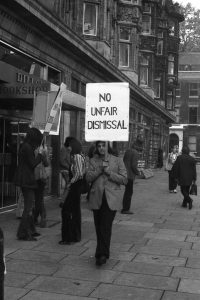
Dillons was unusual in being one of the only two bookshops in London where the staff were unionised (the other being Colletts). I joined the union, the TGWU, and felt very ‘grown-up’, although the weekly dues came out of my rather tightly stretched pay packet. In the summer of 1974 there was a dispute with management and I suddenly found myself with all my friends on the pavement outside the shop, forming a picket line. It was all very exciting, although I was deeply conflicted since I loved the job and shop and worried that I might find myself unemployed. We all received formal letters of dismissal. The strike went on for several days, and it was exciting to feel solidarity from some members of the public. Taxi drivers would stop and shout encouragement from their cabs, and many of our academic customers were very supportive. There was a small protest march along Torrington Place. We were all finally re-instated in our jobs, much to my relief! I think being on strike had quite a profound effect on me: in earlier life and at university I think I may have been rather right-wing in my views, and now I found myself identifying much more with a socialist streak in my character.