A Career in Publishing
On this page...
Training
In Apr 1974 I had a call from my godfather, Cyril Watney. He wanted to know if I’d seen an ad in the Bookseller? Longman wanted a rep in Mexico, and Cyril thought that I might be interested. The next thing I knew I was in Harlow being interviewed for the Mexico job. It all seemed very improbable to me: the HR person in Harlow refunded my travel expenses, and I was told that they would let me know in due course.
A few days later to my great surprise I was offered the job. Could I start in July, spend a couple of months training, and set off for Mexico in September? I was delighted, especially when I later learned that more than 300 people had applied for the job. I was to start on a salary which seemed absolutely enormous to me. Sherry was pleased because she had recently resigned her job as receptionist in the Children and Parents unit of the Tavistock Clinic and was wondering what to turn to next. My pals at Dillons were less impressed. Longman did not have a good reputation in the bookselling world: when we quoted delivery times on orders, which were three weeks for most publishers, we had to tell our customers that Longman books took five weeks to arrive – in addition Longman seemed prone to make mistakes in order fulfillment and things often had to be sent back and re-ordered, all of which created more work for us.

I started my job in July, and was given an office to share with an older chap who seemed very jaundiced about the company, and was indeed on his way out. It seemed that nobody really knew what to do with me. I was given some files to read through, and had a few sessions with the Sales Administration Assistant for Mexico who gave me a run-down on the principal accounts there. On the whole, I was left pretty much to devise my own programme. I met Michael Wymer, one of the senior people who had interviewed me in the lift, and he asked me how things were going. He must have been alarmed by my reply, because he took me under his wing (although technically I didn’t report to him) and asked me to come and see him once a week to discuss what I was doing and what I was learning. I found this very helpful, and benefited from his kindness and advice. One of the things which I did was to take a course in teaching English as a Foreign Language (TEFL) course at International House, which I enjoyed. Of course, I had had teaching experience in Mexico, which was one of the things which had landed me the job, but the training I had received was limited, and I needed to be able to speak knowledgeably about modern EFL pedagogy and relate it to our products.
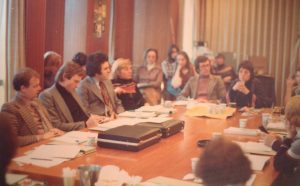
I was also helped in that by attending the mid-year sales conference which took place in Harlow: it was very exciting because I met all my colleagues from different parts of the world, and I also met some of our key authors who came to talk about their work. These included Louis Alexander and Brian Abbs. Brian gave a presentation on what was the cutting edge in language teaching pedagogy at the time: the functional-notional syllabus. It all seemed very exciting indeed: there were interesting ideas to engage with, interesting and enthusiastic people to get to know, and I was being paid an enormous salary (well, enormous compared to what I had been earning as a bookseller. I think my initial salary was £1,200 a year, but there was an ‘overseas allowance’ on top of that, and best of all, I wouldn’t be paying any taxes once I was living in Mexico again).
Back to Mexico
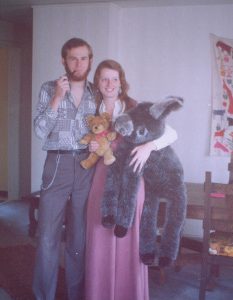
In September Sherry and I said goodbye to Hampstead and set off for Mexico. In Mexico City we took possession of the company flat, a huge flat in Polanco, on Calle Ruben Dario. I also took possession of the company car: a Ford Maverick which was primitive mechanically but had a huge V8 engine and was therefore ridiculously over-powered. It was a joy to have a car at my disposal for which all expenses were paid: insurance, taxes, maintenance, etc. That car had a lot of use as the official Longman car in Mexico. I don’t know how many kilometers I put on the clock, but it visited most of the republic over the next couple of years, including a trip to Guatemala. I should also mention, to my shame, that the first time I drove it I had a pipe in my mouth, and backing out of the garage completely failed to spot a lamppost which was directly behind me. The sudden stop was quite a shock, and although I owned up to the company I did insist on paying for the repairs out of my own pocket!
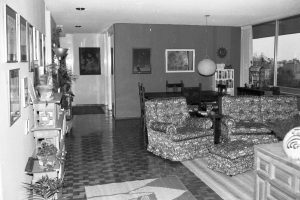
Sherry and I didn’t like the flat: it was in part of town which I didn’t like very much, and it was far too large. After living in a bedsit in London it was unnerving to find that your partner could be in the same flat and yet you had no idea of where they were! As ever, Granny Golding came up trumps. She found us a lovely flat in a brand-new building on Calle Parroquia in Del Valle, and that was much more to our taste in terms of location and size. It was great to be back on the south side of the city.
The Call of Academe
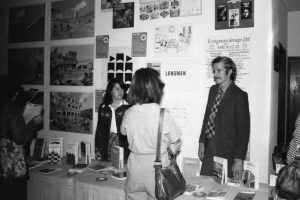
One of the things I really liked about the job in Mexico was attending the international conferences for language{{ reminisce:longman005.jpg?direct&200|Booth at a convention, Eunice Velasco de Sarmiento to my right}} teachers and applied linguists. I was interested in the theoretical underpinnings of language teaching, which at the time was attracting a lot of interest from academics. When I joined Longman the question of syllabus and how syllabus could be constructed in a way to help the learning process was very much a live issue. Louis Alexander had pioneered the structural syllabus, and he and others were involved with the Council of Europe in defining competencies. Brian Abbs and his associates were just moving into the realm of functional syllabuses and the first volume of the ground-breaking series Strategies had just been published. Questions were being asked about how people learned languages, and controversy had been stirred up by Stephen Krashen who (to my mind persuasively) argued that there was a difference between the cognitive processes of ‘learning’ a language and the more unconscious, instinctive processes of ‘acquiring’ a language. I heard Krashen speak at a TESOL conference in Guadalajara, and was intrigued by what he had to say.
By the time I had been in the job for a couple of years I had persuaded myself that I would like to return to the world of academe, and I started to consider where I might enrol for an MA in Applied Linguistics. In 1976 I formally declared my intention of resigning from Longman, with the idea of taking up a course from September onwards. Sherry seemed resigned to this, although she at the time was well-established teaching English for the Instituto Benjamin Franklin, which she enjoyed very much and where she was much appreciated by students and staff. She also enjoyed living in Mexico and was beginning to feel much more confident about her ability to speak Spanish.
Lure of the Eastern Mediterranean
In the meanwhile, Longman’s international sales team was undergoing a bit of an upheaval. Julian Amey, who had been manager in Spain, was being re-assigned to the Greek desk. However, the manager of the Brazilian operation had tragically died in car crash, leaving the Brazilian job open, and it was offered to Julian. Paula Kahn contacted me and asked whether I might be interested in shelving my academic plans in favour of a job based in the Eastern Mediterranean. The job was based in Athens, but involved responsibility for Longman’s business in Turkey, Iran, Israel and Cyprus. Sherry and I discussed this, weighing the attractiveness of a year in perhaps Lancaster with an uncertain future after that, as against three years in Greece with the possibility of a further career with Longman afterwards. It wasn’t a long discussion, as I recollect. Greece won hands down!
Two Years in Athens
Much could be written about the two years we spent in Athens. I will do that some day!
Back to Harlow
After just two years in Greece, I was offered the job I really wanted: a job on the editorial side back at HQ with the possibility of promotion and development. I was sorry to leave Greece so soon, and had made many friends there, but my career depended on the move. Sherry and I returned to the UK in August 1979, and I took up the job of Publisher in the English Language Teaching division. We decided at that point that we were going to buy a place of our own, and we wanted to live in London. Even then the prices of properties in London were seen as very high compared with average salaries, and it took us many months of searching before we found the house at 49 Defoe Road. In the meanwhile we lived in a variety of places: a company flat in Harlow (an eye-opening cultural experience), a few weeks at Julian and Victoria Amey’s flat in Islington, and a rented flat in Crouch End, notable for its smell of stale tobacco and its dodgy electrics.
In the updraft
Once back at headquarters, I found myself in the ‘updraft’ and promotions kept on coming. I came back as a junior publisher, and in Oct 1980 I became a fully-fledged Publisher. In Nov 1982 I was promoted to Publishing Manager.
\
\
Oct 1980 Publisher at Grade 10\
Nov 1982 Publishing Manager at Grade 11\
Apr 1984 Publishing Manager at Grade 12\
Dec 1985 Editorial Director (non-Board directorship)\
Oct 1986 Divisional Director of Home Ed and Ref Division as well as Ed Dir of ELT Div.\
Apr 1989 Managing Director, Academic Scientific and Technical Division\
Crashing out
In September 1991 I suddenly exited the ‘updraft.’ This was brought about mainly by internal politics in the company, and my finding myself on the wrong side of a misguided attempt to rescue a small business which had been acquired by the company a few years before and which as going wrong (Architecture, Design and Technology Press). My attempts first to rescue the business, and then to dispose of it, backfired on me and caused embarrassment for the CEO in her relationship with Pearson, the owners of Longman. However, instead of being fired, I was offered the possibility of doing a subsidised MBA at Ashridge Management College, with a focus on a project which was of interest to the company. There was no guarantee of a job with Longman at the end of the MBA.
Ashridge
I spent 1992 doing my MBA at Ashridge. I thoroughly enjoyed the course and did well on my main project which was “The Corporate Marketplace for Language Learning in Europe.” I traveled quite a lot during the year and was especially excited by the opportunities for offering ‘blended learning.’ I felt that Wall Street Institutes and Shenker in Italy illustrated the opportunities, and I got quite close to both businesses. My recommendation to Longman was that they should moved into a new type of business: instead of publishing materials to be sold to third parties, why not publish materials to be used within a tightly specified and well-branded delivery system, which could be rolled out through a franchise model.
Back to Longman/Pearson Education
My proposals attracted some interest, and were supported especially by Paula Kahn. I returned to Longman formally in 1993 charged with finding a way forward. My initial attempt was to persuade the company to acquire Wall Street Institutes, which they could have done at quite a reasonable price. However, the meeting I arranged between our new American senior management (Longman was already fast disappearing as an independent entity into a corporate mash-up called Pearson Education, based in the USA) and the Wall Street Board did not produce the results I had wanted, with the American CEO failing to understand the nature and strategic relevance of the Wall Street business. I fell back on Plan B which was to develop a model entirely from scratch, and I approached Louis Alexander to write the materials, something he responded to with enthusiasm. Thus was Direct English born.
Direct English

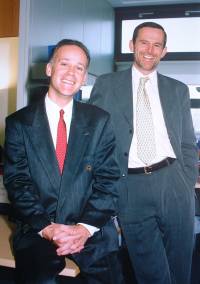
The Direct English project developed like a sort of ‘skunk works’ within Pearson Education. With all the changes going on at senior management level (Longman effectively ceased to exist in Sept 1994). I don’t think anyone took much notice of us. Louis Alexander, Sarah Gumbrell and I developed a set of materials based on video mini-dramas written by Daisy Miller and filmed by Mike Raggett.
As soon as we could we opened a pilot school in Milan owned by and managed by Howard Scott, and we started developing the model for delivering the service, which was to be based on the notion of flexible access by the customer who would have first-class self-study materials backed by on-demand tutorials. We brought in specialists in franchising, notably Clive Sawkins, and by 1996 we were negotiating a Master Franchise contract in Korea. The business was beginning to take shape, and it was felt that someone from outside publishing should be brought in to oversee the business. Moira Craig was appointed as Managing Director, with me as Operations Director. We were coming under enormous pressure to grow the business fast, and Clive Sawkins was busy signing up Master Franchisees all over the world. Many of these were signed up for reasons of expediency, and we came a cropper in a couple of cases, notably in France where we incautiously started franchising without protecting ourselves properly from the notorious ‘Loi Doubin’ which left us exposed to legal action by the franchisees. Moira had left as MD, to be replaced by Clive Sawkins, and then he too was pushed out. I was given the job of MD with a view to stabilising the business and possibly making it ready for disposal. In 2003, just as it finally moved into profit, the business was sold to Linguaphone (CEO: Clive Sawkins), and that marked the end of my career in publishing.