Early days and school days
On this page...
Home schooled in Irapuato
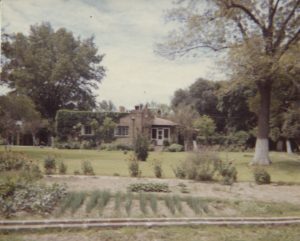
When I was six or so, my father worked for Cigarros El Aguila, a subsidiary of British American Tobacco. He was transferred to a town called Irapuato, in the middle of Mexico’s main agricultural area. We lived in a company compound, which consisted of two bungalows set in a huge garden. My recollections of the time are happy ones. I remember that there was a wood pile where timber for fireplaces was brought, and on one occasion there was a broken up wooden toy, painted red, with little wooden wheels. I was very captivated by this, and ardently hoped that another one would be brought along so that I could play with it, perhaps put it together again. I used to go out every day and check, but there never was another one. There was also a large water tank, open at the top, and occasionally on hot days we were allowed to climb into it. I have fond memories too of lying on the floor under the piano while my mother played. There was something very sensuous about that. I also learned how to ride a proper bicycle in the compound.
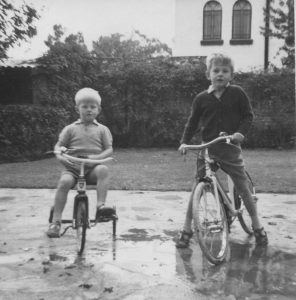
I had reached an age where I might be expected to go to school, but my mother didn’t think there was a suitable local school. She enrolled in something called the PNEU (Parents National Education Union), based in England, which sent out lessons by post which mothers could use to teach their children. My mother undertook to teach me, and I learned the alphabet and basic arithmetic and the like from her. She taught me to write. I am right-handed, but she was left-handed. I have always bent my wrist around when writing, and people think I’m left handed, whereas of course I’m not, but that was the way my mother wrote. It’s never been a problem for me except that I tend to smudge the ink on the lines I have written, since my wrist travels over the lines written rather than going underneath them on the blank paper. I think I enjoyed my lessons, and my younger brother, being two years younger, was excluded from that part of my life. He told me once we were adults that far from envying me the attention, he felt sorry for the deprivation of liberty from which I apparently suffered!
Move to Guadalajara
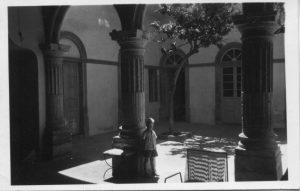
My father left his job with British American tobacco. I’m not sure why: it could have been that they wanted to transfer him to somewhere he didn’t want to go, or it could be that the job wasn’t working out for him. Anyway, he found another job which meant moving the family to Guadalajara. At any rate, we found ourselves living for a short time in a beautiful colonial house somewhere in the city. I remember the lovely central courtyard with pots full of flowering plants and the large spacious rooms surrounding it. We didn’t stay there for long, however, and had soon moved to a brand-new house in a suburban development. It was in my memory quite a small house with a small garden raised about street level. There was a flight of steps down to the garage which was underneath the house.
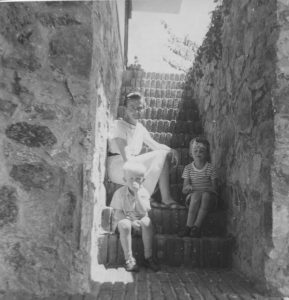
I remember one day being out in the garden playing with some toys. Eventually I came back indoors and immersed myself in a book. My mother asked whether I had left my toys in the garden, and asked me to bring them in. I walked out and forgot entirely about the flight of steps leading down, which were not protected at the time by a railing. I walked straight off the edge and fell onto the brick steps below. I may have been slightly concussed: my next recollection is of being clasped in my mother’s arms and being told that she was taking me to the hospital. I was aware that her blouse was covered in blood, which I found out later was pouring from a gash in my forehead. I had to have stitches, and to this day have a slight scar on my forehead dating back to that incident. If you look closely at the photo, you will see that my forehead is bandaged!
Thinking about this now, it must have been an extremely stressful time for my family, although I was not consciously aware of it. There was the move to Guadalajara, which was an unknown city for them, my Dad starting a new job, a couple of moves in a short period of time and my accident. I learned later that all was not well with my Dad’s job: it was in the import-export business, and not long after he started working there the owner was arrested and put on trial for smuggling! That was the last straw, and the family moved back to Mexico City. Granny found us a nice house on Calle Hortensia in the Colonia Florida, and we settled in there for a good many years. My Dad got a job with ICI, which he liked (at least for the first few years) and the family was settled enough to consider what schooling should be provided for my brother and myself.
Discovering Geography
The family moved back to Mexico City from Guadalajara in 1958, I think.
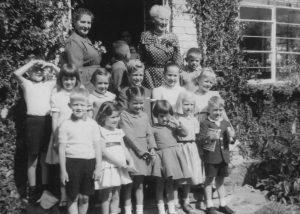
In Mexico City my home-schooling ended because my parents found a small English-medium school in San Angel, which was run by two fierce but big-hearted women. One was Mrs Boyle and other was a French woman called Mme Pierrati. It was a small school, with maybe 20 children, and was located in the gardens of a huge house belonging to a grand Mexican family. I remember that we were allowed during breaks to play in the beautiful gardens. My brother and I went together, and I remember on that first day my brother was very upset and cried, while I was terrifically excited to be going to a real school, with what seemed like lots of other children. One of my fondest memories of those days was the discovery of geography: I remember vividly being set the task of making a map of an imaginary island and showing things like mountains, lakes and rivers on the map. This for me was a most blissful activity and I remember doing lots and lots of maps with increasing amounts of detail. I think that was the origin of my love of geography, which I ended up studying at university, and which fascinates me to this day. It was also at that school that I had my first encounter with the French language, which was of course taught by Mme Pierrati. I remember at the end of term performance having to recite a verse in French which was La Fontaine’s ‘La cigale et le fourmi’. I can still remember ‘La cigale, ayant chanté tout l’été…’ I rather doubt that in those days I had any appreciation of the pluperfect tense, but that didn’t bother me at all!
Mr Stech’s school
I think the Boyle-and-Pierrati school only lasted for about a year. We then went to another new school which started up in Mixcoac. This school was on Calle Jaime Nuno (no. 59 if memory serves) and was in the servants quarters of a house owned by a Mrs and Mrs Stech. Henry Ronald Stech was a Canadian man, who had been running a troup of scouts. He had quite liberal views on education, and I liked him. We all went in fear of Mrs Stech, who was a small woman who seemed very fierce, although I suspect that she wasn’t really. There was no schoolyard to enjoy, and we used to go around the block at break time to a vacant lot on a parallel street. I remember that that is where I first played football with something that felt like a real team, and it was great fun.
Edron
After a year or so Mr Stech went into partnership with a Welshman called Edward Foulkes. They founded a new school which was called the Edron Academy (combining the names of Edward and Ronald, presumably because ‘Edhen’ didn’t have a ring to it!). This school started in a house which was rented for the purpose in San Angel, on Calle Palmas, and I was to spend the rest of my school education at that school, although it eventually moved to bigger premises on Calle Calero. It was just as well for me, because had it not started, I think my brother and I would probably have been sent away to boarding school in England.
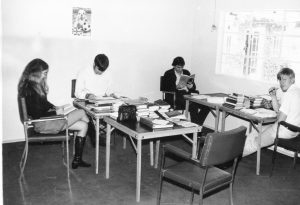
The Edron was a small school, although it grew considerably. It was founded on very liberal educational principles, and I think Foulkes was much influenced by the likes of A.S. Neill. Foulkes was the headmaster and initially he and Stech did all the teaching, although before long they had other teachers join them. For a period of probably 9 or 10 years Foulkes was just about my only teacher, and his main subjects, history and humanistic geography, were the things I enjoyed too, no doubt because of his inspiring teaching. I don’t remember him giving any formal classes, but he used a tutorial method of suggesting readings and inviting discussion. I feel a huge amount of gratitude to Mr Foulkes, because his philosophy was such a benign one and at the same time he had an intellectual rigour which communicated the excitement of engaging with ideas, and he certainly helped to foster in me a belief in myself and my abilities. On the downside there is no escaping the fact that it was a small school and there was little opportunity for developing in certain areas, and notably in the sciences. We did have a small lab and some equipment, and occasional science teachers who would come and go, but the idea of doing physics say, or chemistry, up to ‘O’ Level just wasn’t on the cards. I’m not quite sure how I managed to do my ‘O’ Level maths! My main memories of chemistry was finding a recipe for making a kind of gun-powder, and then manufacturing it with a couple of friends in the small lab. We experimented with small rockets (made of paper wrapped around a pencil and fastened at the top end, then the pencil was replaced with the propellant), some of which flew in a very satisfying way and most of which fizzled and sputtered but never showed any real potential for flight! I’m somewhat surprised in retrospect that we never had any even small explosions, though that must have been a real risk. There was also no organised sport at school, though I did play a lot of badminton and a rather violent game called ‘dodge ball’ which was immensely thrilling and which I excelled in.
The Edron Academy still exists, although it is significantly larger and offers a broader curriculum than it did in my day. Ironically, its new location is almost next door to where we used to live in the Desierto de los Leones!
Riding
One of my earliest memories is of falling off a horse. My grandfather was a keen rider and owned horses, and on one occasion he had brought his horse around to the gate of Comunal 52, and I was hoisted into the saddle. I don’t know what happened, but I fell off, and I remember lying on the sofa in the sitting room and being given a glass of sugar water. Dr Cabazos from next door was brought into examine me, but needless to say there was nothing wrong. I must have been about three years old.
When I was around 10 I started riding regularly, and this continued until I left for university. My grandfather always had three or four horses, and we used to ride the same one each time. I was the principal rider of a series of horses, starting with Ebano and going on to Poblano (a rangy and tall thoroughbred bay gelding), Huixquilucan (known as Whisky) who was a short powerful horse with a devilish sense of humour, and Indio aka Dragon, another thoroughbred gelding who behaved like a stallion and frightened a lot of people but who would do absolutely anything for me.
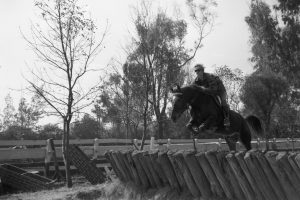
At first the stables were in the Colonia Florida, only a few blocks away from where we lived. Then the land there was developed and the stables became a posher riding club at the top of Avenida Constituyentes, called Club Hipico Azteca. We used to ride five times a week, and during the school week we would get up early, have breakfast while it was still dark, drive to the club and ride for an hour, before being driven to school. Most of the riding was done in groups in the club’s main paddock, starting with warm-up exercises and leading on to jumping. At weekends we would ride out into the countryside, which I really enjoyed. There were many ravines and some interesting topography to negotiate on horseback. As I got older I became interested in dressage, and made some progress in this on ‘Dragon’ who was capable of being incredibly neat and collected.
It was good exercise, and quite sociable, and compensated for the lack of organised sport at school. I often resented getting up early and used to complain to my mother about it, but in fact it was enjoyable and a privilege to enjoy sunrise in the valley of Mexico before the smog obscured the surrounding mountains. {{reminisce:equestrian001.jpg?direct&200 | My mother on Gitana}}Of course you can’t be a serious rider without suffering a fair number of falls and injuries, but although I fell often I was never badly hurt. When at 13 I wandered around with my arm in a cast people assumed it was because of the ‘dangerous sport’ I practised whereas in fact it was due to an awkward fall during an intense badminton game at school! My mother wan’t so lucky and she had a number of spectacularly bad falls. After one of them, when she was hospitalised for a few days having had a badly fractured arm and most of her face torn away when her horse ‘Gitana’ miscalculated and fell into an obstacle, my father took one look at her before the ambulance came and vowed never to ride again. He said as the family’s principal breadwinner it was just too risky, and I can see his point. My mother never gave up, though, and was always back in the saddle sooner than she should have been.
Wheels!
In 1964 the family moved out of town to the new house on the road to the Desierto de los Leones. The house was lovely and the setting was lovely: set well back from the road, with ravines dividing us from our neighbours and with a panoramic view of the southern part of the Valley of Mexico and the Cuernavaca hills (including Ajusco). This was all very well and exciting at the age of 13. However, by the time I was 16 I was only too well aware of the isolating aspects of it. The only ways to meet up with friends or to have an independent social life involved taking an infrequent, crowded and very smelly second class bus down to San Angel, and then another bus on from there if necessary, or alternatively to hitch-hike, which my brother and I often did (I’m sure our parents would have been horrified – and worried – if they had known).
I suppose it is no wonder then that my brother and I became obsessed with cars. My biggest dream was to own my own car, and of course that was not really going to be possible until I reached the age at which I could obtain a driving licence, which in Mexico was at 18. My mother taught me how to drive, using a small private road leading into the riding club, and also an unmade road/dirt track behind the Colegio Militar and which led down towards Las Aguilas. My brother and I often drove the car along that road: my mother did a deal with us that if we helped her to bring stones and boulders back for some of her various garden projects, we could drive once we were off the main road.
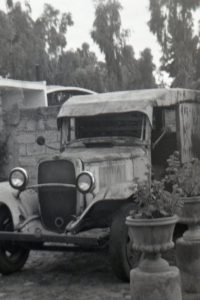
At that time in Mexico there were still some vintage cars around, and I became very keen on the idea of buying an ‘old wreck’ with the idea of restoring it lovingly and selling it eventually for a profit. I think Uncle Jimmy colluded in this pleasant fantasy. It must have been in 1967 or 68 that the first candidate was selected: a beaten-up old 1933 Chevrolet truck, which Richard and I bought for next to nothing. The engine was the best thing about it: it ran powerfully and reliably once started. The gearbox wasn’t in good shape, and the brakes didn’t really work. The handbrake worked, after a fashion, but the ordinary brakes did not. My mother colluded, and although I had no licence, I drove the truck home in triumph. Alas, on the way up the hill to the house I had to stop at one point and could not engage first gear. The truck began to roll backwards, and of course the brakes were unresponsive. There was a horrible crunch as I hit the car behind. Fortunately the car behind was of course my mother’s who had been anxiously following, and the damage wasn’t too great. Still, it wasn’t a good augury.
We had good fun with the old truck, but the restoration never really got under way properly. We stripped it back to its original flatbed self and painted it a satisfying dark red, but mechanically nothing much was done to it, and it became obvious that it was never going to be realistic proposition to make it roadworthy enough to obtain the necessary permits to use it on public roads.
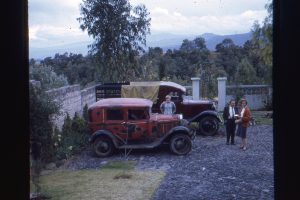
We kept looking for our ideal, which was a Model A Ford. I think we were about 5 years too late, since most of the remaining ones had been bought by collectors. We did eventually find one, an almost complete wreck, and had it towed to our house. As a collectors item the car was far from ideal. Not only did it have almost no interior furnishings at all, but somebody had removed the original flat roof and soldered on a new, higher roof, which was rather ugly. It fairly soon became clear that the car was well beyond my mechanical abilities. I got it running, after a fashion, and once I had my licence I risked taking it on the road to the ‘Registro Federal de Automoviles’ to obtain proper papers for it, which was a long, frustrating and uniquely Mexican bureaucratic odyssey. From the ‘registro’ the car went to a professional mechanic, who struggled to get the engine and rest of it working properly, to little avail. Eventually it was sold for about what we had paid for it.
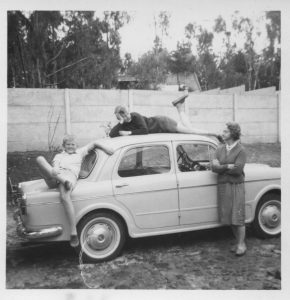
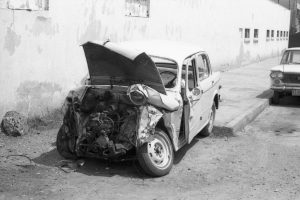
The priority at that point was to have a car which was sufficiently reliable and comfortable to use for travel around the city and in particular for taking girls out on dates. Richard and I pooled our savings and stuck with family tradition, buying a nice little second-hand Fiat 1100, which ran nicely and was entirely roadworthy. We didn’t have that car for very long, because it was subjected to an unfortunate crash one night when it was completely totaled. Five of us in the car got out relatively unscathed. None of us had been wearing seat belts (there were none in the car). I was probably the worst injured since I boke my bottom front teeth (I think they came in contact with the rear-view mirror). Richard and I were both doing casual work at the time, including giving private English classes, and so it wasn’t long before we were able to afford another little Fiat and our social life was restored to us. Richard at about that time bought a rather spectacular-looking 1946 Ford roadster with the idea of turning it into a hot rod by putting a modern V8 engine into it. I’m not sure how far he got with that project because before any progress had been made I was off to university in Canada.
Addresses and dates
Granny and Uncle Richard kept a list of addresses for the family in Mexico, which is useful in terms of places and dates.
1952-3 Calzada Comunal 52, Fraccionamiento Acacias, Colonia del Valle, Mexico 12 DF (my grandparents’ house)
1953-5 Avenida San Jeronimo 92, Villa Alvaro Obregon, Mexico 20 DF
1955-7 Valerio Trujano 298, Mexico 12 DF
1957-8 Calle Escobedo 65, Irapuato, Guanajuato Mexico
1958 Sinaloa 208, Guadalajara, Jalisco, Mexico
1958-64 Hortensias 197, Col. Florida, Mexico 20 DF
1964-1977 Calzada Desierto de los Leones 5696, Mexico 20 DF