Travels and Excursions
On this page...
A visit to Guatemala
In June of 1975 Sherry and I took a road trip to Guatemala. I had business to do in Guatemala City and we decided it would be interesting to combine this with a short holiday. We needed to obtain visas, and Sherry with her Canadian passport obtained a free visa immediately. My UK passport was more problematic: it took a while and I had to pay for the visa. The reason being that Guatemala was annoyed with UK over the independence of Belize. We were interested to see that in Guatemala all maps showed Belize as a province of Guatemala!
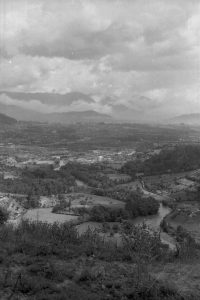
We drove down through San Cristobal de las Casas, where I think we must have spent the night. Then we crossed into Guatemala and visited Solola on Lake Atitlan before driving on to Guatemala City. We found a hotel room there which seemed fine at first sight, but as the night wore on it became evident that the room next to ours was being rented by the hour. The next day or two were spent on business in Guatemala, visiting bookshops and schools which used our books. One bookseller in particular struck me as being a great character. He was called Tuncho Granados, and as he drove me around at breakneck speed in a tiny van he shouted and gesticulated at the ‘indios’, making outrageously racist comments. Guatemala is as ‘mestizo’ as Mexico, but the autochthonous people were far more evident than in Mexico, being more like Ecuador and Peru in their use of native dress. Granados told me proudly, it seemed, that Guatemala’s sympathies in the second world war had been firmly on the side of the Reich. He may have been pulling my leg, but I was quite relieved when I was able to dispense with his company.
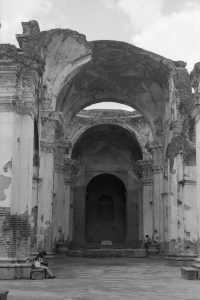
Business concluded, we paid a visit to Antigua Guatemala. We were told about how often the city had been destroyed by earthquakes and then rebuilt. I asked the guide when the next earthquake was expected. She said that in all seriousness the scientists estimated that one was due within the next five years. It could be any time. That night, back in Guatemala City, we woke up in the middle of the night to the sound of groaning masonry, and the whole building was rocking gently. Fortunately it proved to be only a minor tremor. In February 1976, however (less than a year after our visit), a huge earthquake struck, causing more than 25,000 deaths.
The return journey was full of incident. At the border with Mexico we paid a hefty exit toll on the Guatemalan side, only to be told on the Mexican side that Sherry couldn’t be admitted because she needed a new entry visa. We were recommended to return to the Guatemalan side where the Mexican consul could issue a visa. We drove back across the river to the unprepossessing village and the border guards there told us we would have to pay the entrance and exit tolls all over. After a wrangle they said I could park the car in no-man’s land outside the border post and we could walk through at no charge. Needless to say, the Mexican consul couldn’t be found and we had to find a place to spend the night. There was a guesthouse in the town (it certainly didn’t merit the name of hotel), and we found a room there. It was a wretched night: the walls around the room didn’t reach the ceiling, so it was very noisy, there was a jukebox nearby which blared music seemingly all night long, and there was a massive thunderstorm in the early hours. In the morning, jaded and tired, we waited for the consul to turn up. He eventually did arrive, and although he was initially unhelpful and suspicious, when he discovered that Sherry was a Canadian he became very expansive, told us how much he liked Canada, etc. and cheerfully issued the necessary documentation.
We returned to the car, I engaged reverse gear to back away from the fence we were parked against, and there was a horrible bump and grinding sound from the rear of the car. I leapt out and discovered that a large pointed boulder had been placed just under the petrol tank, and petrol was streaming out. The stone had clearly been put there deliberately. The border guards were delighted. ‘Now you will have to pay your entrance charge so that you can have your car repaired’ they told me gleefully. I refused and drove across the bridge preferring to take my chances on Mexican territory. On the Mexican side our documentation was accepted, but they said the car would need to be fumigated. We stood there and watched as the car was filled with noxious fumes, while petrol flowed in a small but steady stream out of the tank. As soon as we were cleared to drive off I hunted for a shop which sold chewing gum, and Sherry and I chewed large wads of gum until our jaws ached. Once it was suitably softened I packed the gums around the damaged area of the tank, and managed to stop the leak. The chewing gum patch served us well all the way to Mexico City, over 1000 kilometers away. I knew to use the chewing gum because of a story I had read about pilots in WW2 using gum to patch tanks when they were holed by bullets.
We drove back through Chiapas, and had to put up with the lottery of border control posts which are scattered at random all along the road to San Cristobal. A post would appear suddenly at the edge of the highway just after a curve, requiring a fast stop. They were usually deserted, but there was no way of knowing until one had stopped and checked. Of course, driving past a post without stopping could have resulted in a hail of bullets, so that wasn’t an option! The other menace was livestock on the road. Driving through one village Sherry suddenly shouted ‘Michael! Watch out for the pig!’ I slammed the bakes on, narrowly missing a piglet which had been pushed in front of the car by a couple of youths standing beside the road. It would have been a very expensive bit of ‘cochinita pibil’ if I had hit it! Later in the afternoon Sherry was driving, and we were on a long downhill stretch. Near the bottom there was a peasant with a cow. Sherry slowed down, but as we got near, the cow was prompted to amble across the road in front of us. Sherry braked hard, the car slewed, smoke streamed from the tyres, and I kept saying: ‘we’re going to hit it, we’re going to hit it!’ The car stopped, at right-angles to our direction of travel, about a foot from the cow who looked into the window at Sherry’s white face.
After hours of ‘skirt and climb’ (winding mountain roads) in the hot sun, we finally reached the outskirts of Oaxaca were we planned to spend the night. I got out at a shop selling mezcal, and rather incautiously had a ‘taste’ of several varieties on offer. When I got back in the car I realised that it would be foolhardy for me to drive. Sherry was not pleased at all to have to take the wheel to complete the journey to the hotel in the town centre!
Volcano
My opposite number in Mexico was Phil Cooper. He was a hard-living, hard-partying Welshman and rugby player, and a generally nice guy. He was the representative of Oxford University Press in Mexico, and he and I made common cause against MacMillan, which dominated the ELT market in Mexico at that time. Phil and I had sometimes talked about climbing mount Popocatepetl, one of the two snow-covered volcanoes which stand over the Valley of Mexico at the south-eastern end. One day Phil told me that he had put together a party of friends who were going to attempt the climb, and would I like to come with them? I eagerly accepted.
Apart from its height, Popocatepetl is a fairly easy and safe climb, unlike it’s sister mountain Ixtaccihuatl to the north. There have been many climbing tragedies on ‘Stassie’ as we used to call Iztaccithuatl, but relatively few on Popo. We hired crampons, piolets and ropes, but it was unlikely that the ropes would be needed. The main problem was the weather: under clear skies the climb would be straightforward, but clouds can suddenly envelope these mountains, leading to the possibility of severe and dangerous disorientation, especially on the descent. Ropes are useful as a way of keeping a party together in zero visibility.
We set of one Friday afternoon in several cars. I think there were six of us in the party. We drove up to the town to Tlamacas. From there we walked up to a climber’s refuge at about 3,500m, where we spent the night. At about 4am we started off, in the pre-dawn cold, under clear skies. It didn’t take long before we were at the snow line, and from there it was pretty much a straight climb to the top. The going was very hard: the cone is all volcanic ash, covered in wet snow, and our feet would sink in deeply at every step. The altitude was of course the main problem: over 4,000m the air seems very thin indeed, and the climb puts a huge strain on the lungs. One weird thing was that after the sun rose and day got hotter, the ‘snowline’ receded up the mountain, and we kept finding that once more it was above us, as we slogged up through the ash.
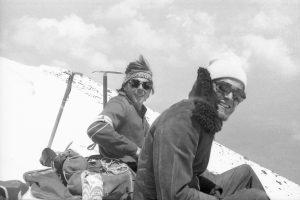
Another chap (whose name I have forgotten) and I reached the crater by the middle of the morning, and from there we made our way up to the peak (5,450m), which is at the south-western end of the crater. By this time there were some clouds around which would come and go with startling speed, but in the clear moments we had the most wonderful views, including Iztaccihuatl to the north, Citlaltepel (Pico de Orizaba) to the the east and the Nevado de Toluca in the far distance to the west. The Valley of Mexico extended below us towards the northwest, although the usual smog of Mexico City meant that not much of the great metropolis was visible. One of the main features at the top of Popo is of course the crater, which had long been dormant at the time of our climb. Although it was dormant, there was still activity visible in the form of steam, bubbling mud and the a very overpowering smell of sulphur. 20 years later, in 1994, the volcano became quite active again, spewing gas and ash over a large area and causing the evacuation of all nearby settlements. It would not have been possible or wise to attempt such a climb under those conditions!
My friend and I waited for the rest of the party, and shared the basic provisions we had carried with us. When it became apparent that nobody else was going to join us, we started on our way down, and met the rest at a point well below the snowline. I think the altitude and the heaviness of the walking had caused them to decide against making the final push to the summit, and they may have been wise. By late afternoon we were driving back to Mexico City and for me there was the huge satisfaction of achieving something which I had thought might be beyond my abilities.
Bicentennial USA
I’m not sure how I managed it from a work point-of-view, but in 1976 I managed to get six weeks off, and Sherry I did an 11,500km road trip from Mexico City to Ontario and back. We left Mexico City on the morning of June 29th, 1976 and drove straight up to Houston, where we stayed with our friend Christine ‘Tina’ Brandeski and her sister. We spent a couple of days there, and had a memorable evening when Sherry and I made dinner for Tina and a group of her friends. A crucial ingredient was garlic-infused yoghurt which was liberally applied to all the dishes of spaghetti as part of the sauce. Unfortunately, I failed to sample the ‘plain’ yoghurt which we had bought. Indeed it was plain in the sense of being unflavoured, but it was also full of sugar. The dinner was, I’m afraid, inedible!
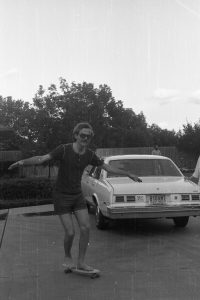
From Houston we travelled to Fort Worth, where we stayed with our friends Dick and Susana Andrews and their two boys. We were there over the July 4th weekend, which was rather special, it being the Bicentennial of the American Revolution, and there was a magnificent fireworks display in a nearby park. During our visit to Fort Worth there were other highlights, including playing croquet on the Andrews’ lawn, and I had my first ever attempt on a skateboard.
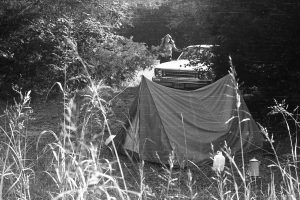
Our next destination was Chattanooga, Tennessee. We camped overnight at campgrounds in Texas (Bonham Park) and Arkansas (Onachita Lake). We had never done any camping before, and so this was a bit of a learning curve for us. {{:reminisce:usacan76-020.jpg?direct&200 |First attempt at camping}}I remember that the first night the tent was somewhat saggy and it was sopping wet when we awoke in the morning, despite there being no rain. We quickly realised that we needed a fly to protect the tent from the dew at night, and it wasn’t long before we had one improvised. I was flumoxed at a petrol station in Arkansas when the pump attendant suddenly said to me “D’jewwancher orlcheck?” He must have thought I was pretty thick by the time I figured it out and said that no, the oil level was fine.
We arrived in Chattanooga on July 7th. The purpose of the visit was primarily to see John Andrews, a friend of ours whom Sherry had met at the University of the Americas in Puebla. We stayed at his parents house, and they were amazingly hospitable and welcoming. We were somewhat embarrassed however by the fact that at supper on the first night we simply couldn’t understand much of what they said owing the broad Tennessean accent. By the second evening our ears were starting to adjust and conversation was much easier. By that time Sherry and I found that we were both suffering from really insupportable itching which was coming from small red bumps around our middles. Sherry finally showed hers to Mrs Andrews who took one look and said ‘Them there’s chiggers’. It turned out that chiggers are a form of tick, and we must have picked them up at one of the camping sites, probably the one in Arkansas. Mrs Andrews gave good advice: coat the skin over the tick bite with nail polish to cut off the oxygen supply. The tick then dies and eventually comes out as pus. The trick is to put up with the near intolerable itching and refrain from scratching. Easier said than done!
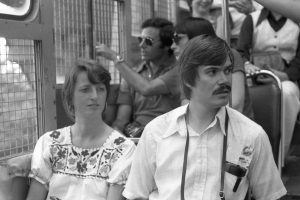
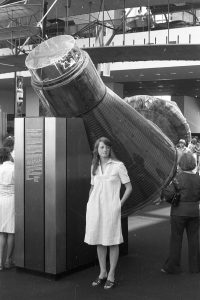
While in Chatanooga we did some tourist things, including the funicular ride up Lookout Mountain, and a visit to Opryland. On July 11th we said goodbye to John and his parents, and drove north east to pick up the Blue Ridge Parkway. The views were fantastic and the weather was kind to us. We camped overnight at the Julian Price Park in North Carolina. Our next stop was Falls Church, Virginia, where we stayed with my childhood friend Andrew Duncan and his wife Idi. We visited Washington DC and went to the Air and Space Museum as well as to the National Gallery of Art.
Our next destination was New York City. Having learned to drive the way Americans drive and given up some of my Mexican bad habits (such as not stopping at Stop signs and never using indicator lights to signal a turn) I had something of a shock when I emerged from the Lincoln Tunnel onto Manhattan. It seemed like complete chaos, with nobody sticking to their lanes, jumping red lights, cyclists ignoring all the rules of the road, and the like. Sherry commented: perhaps you should imagine that you’re back in Mexico City, and that did the trick! I had no further qualms.
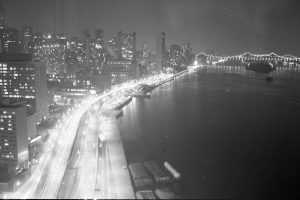
In New York we had been lent an apartment belonging to Brian Kahn, Paula’s brother. It was very special being in a high rise right next to the East River, close to the United Nations. We were on the 23rd floor, and it was thrilling to watch light aircraft flying below us along the river. We enjoyed our stay in New York, and saw a lot while we were there. Perhaps the outstanding events was seeing a production of the Threepenny Opera at the Vivian Beaumont Theatre. We continued our journey through upper New York State and via Niagara into Ontario.
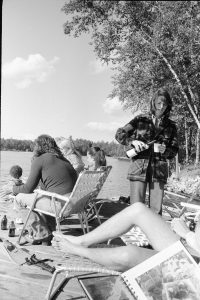
We arrived at Clare and Marlene’s house in the Beaches in Toronto on July 18th, having completed just under 6,000 kilometres. After a pleasant few days in Toronto we continued north up to Jack’s Lake in the Kawarthas, our main destination. We spent a week or so at Sherry’s family cottage, swimming, water-skiing, circle-boarding and partying. Then back to Toronto, visited the Zoo with Clare, Vicky and Marlene, and then on August 9th set off for our return journey to Mexico.
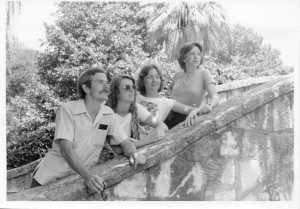
On the return journey we felt like hardened campers, and we stayed at campgrounds in Huntingdon Indiana, Lebanon Missouri and Murray Lake Oklahoma. We spent two nights in Poth Texas with the Brandeski family and visited San Antonio. A highlight of the visit to Poth in the Texas heartland was attending a dance at the ‘Kicker Palace’ in Poteet, ‘Strawberry Capital’ of Texas. That was an interesting cultural experience, where most of the party-goers turned up in pick-up trucks which boasted one or more rifles displayed prominently in the window behind the driver’s seat, and many seemed to have bumper stickers with the legend ‘Kicker and proud’. Kicker of course was short for ‘shit kicker’ and referred to the pointed boots which they wore. None of the men removed their hats as they danced to a live country music band, pushing their partners around the floor as if they were propelling wheel-barrows. It was a very convivial and enjoyable evening.
Finally, with a night’s stop at San Luis Potosi we arrived back in Mexico City on August 15th, having driven 11,418 kms.{{:reminisce:cuidad_satelite_1976.jpg?direct&200 |Arrival at Ciudad Satelite on the way into Mexico City}}
Athos: The Holy Mountain
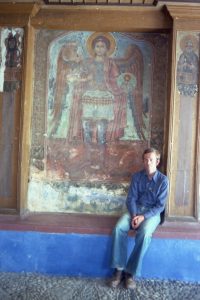
My first trip to the Holy Mountain was in June 1979. We were living in Athens at the time, and I had heard about Athos and was curious to go. My friend George Poulos had been before and the two of us agreed to go. We went to Thessaloniki and obtained a ‘visa’ from the Ministry of Northern Greece, which allowed me to complete the first step of the journey. George didn’t need a visa because he is Greek Orthodox and as such not subject to the same stringent rules as the non-Orthodox. At the time only 10 non-Orthodox were permitted to travel to Athos on any given day.
We drove to Ouranopolis and the following day boarded a ferry bound for the port of Dafni. To board the ferry my visa was required, and the ferry made no stops until it reached Dafni. From there all the pilgrims boarded a rickety bus which drove up a very patchy road (at the time the only road open to vehicles on Athos) to Karyes, the administrative centre. There was a certain amount of waiting around, and then I was awarded a ‘diamonitirion’ which is the official permit to stay. My diamonitirion was for four nights, each of which needed to spent at a different monastery. George and I set off and had a very pleasant and not too arduous walk northwards to Vatopedi, where we spent the first night.
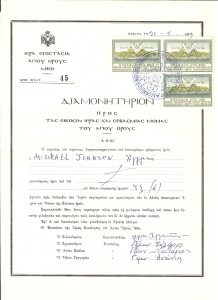
At the time almost all of the monasteries on Athos were ‘idiorhythmic’ which meant that the monks living in them were not bound by any particular communal duties or obligations. Most of the monasteries were in a very poor state of repair, and with dwindling numbers of monks. Vatopedi, although it hard to believe it now, was idiorhythmic, the guest quarters were very dilapidated, and the electricity supply ceased early in the evening. There was certainly no chance of a shower, supper was fairly meagre, and there was no breakfast on offer the following morning, although we were shown some of the treasures including one of the few copies of Ptolemy’s atlas, and were given a coffee before we left.
We walked to Pantocratoros, and managed to get ourselves lost for a while (we were not equipped with high quality maps: I didn’t obtain the Zwerger map until a subsequent visit). We were saved by a friendly monk at the Kellion of Ag. Giorgos, who welcomed us with ouzo and loukoumi. We finally reached Pantocratoros, and in the afternoon did a risky and unacceptable thing when we went off to a sheltered cove well out of sight of the monastery and had a refreshing swim. I wouldn’t risk doing that now! We had a difficult night at the monastery where we were kept awake by a couple of pilgrims who argued loudly with each other until the early hours, and we were then up at 4.00am to attend the morning liturgy.
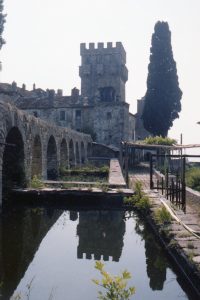
We set off after the service and walked to Stavronikita, where we were given a visit of the Catholikon and enjoyed some lovely mulberries from a tree in the outer courtyard. From there we paid a visit to Iviron, and then caught a boat down to the Grand Lavra. We didn’t enjoy our stay at the Lavra, since the reception we had from the monks wasn’t friendly, I wasn’t feeling well (migraine) and the dormitory was extremely smelly. However, despite all of that, and due to the long day and fresh air, I slept very well that night.
We were up at 5am and attended mattins for a while, and then set off. We had planned to walk around the tip of the peninsula the following day, but I think we took the wrong path, because that the going was rough and we ended up at Ag Theodoros, which is off the main path. From there we made our way down the cliffs to the sea and had a swim. We knew that we would not make it to Aghios Pavlos that day, and thanks to a pocket mirror of George’s we signalled a passing boat, which to our great and intense delight responded and gave us the much-needed ride to Pavlos.
Pavlos proved to be very different to the other monasteries we had visited. It was run along cenobitic rather than idiorhythmic lines, which meant that the monks all observed a common rule of life. It was striking how different it felt: the monks were younger, much more numerous, and followed a fiercely orthodox ethos. Surprisingly I was nevertheless allowed to eat with the monks in their refectory. The food was simple but much better in quality, and it was all grown on the monastery’s lands by the monks whom we saw the following day going out to the fields immediately after the morning liturgy. Of course now (2016) all of the 20 monasteries on Athos are cenobitic and they are all prospering in terms of vocations, as well as being generally in a very much better state of repair.
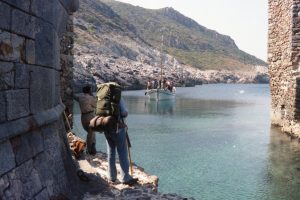
We went down to the ‘arsanas’ (port) of Pavlos to wait for the boat to take us back to Dafni. It was a beautiful early morning and sun was just starting to warm everything up. The sea was quiet and clear and looked incredibly inviting. A young Greek man who was with a film crew who had been at the monastery the day before couldn’t resist, and stripping down to his underpants, he dove in. A few moments later there was a furious shout, and turning around we saw a monk striding down the path and gesticulating sternly. He stood by the water and shouted at the swimmer, who wisely kept his distance and trod water while he was being harangued. Finally the monk bent down, scooped up all of the man’s clothes, including his shoes, and pitched them into the sea, before striding off again! We had a very wet and somewhat repentant man with us on the boat ride back to Dafni. This was a reminder that sea bathing anywhere on the peninsula is forbidden to pilgrims, although George and I had occasionally bathed on beached which were sheltered and far distant from any monastery.
From Dafni we walked up to Xeropotamou which was disappointing since it seemed to be largely in ruins and abandoned, and then down to the great Russian monastery of Aghios Panteleimonos. The monastery was in an abject state of disrepair, and there were very few monks. We were greeted fairly warmly, though, and were shown around by two very dirty and somewhat over-attentive monks. They took us to a room above one of the big churches, where we were privileged to see some of the most amazing treasures to be found on Athos. The room was stuffed full of jewel-encrusted icons, Cartier eggs, and lavish jewellery of all sorts. This was all treasure which had been taken{{:reminisce:img066.jpg?direct&200 |Michael and George at Xenophontos}} out of Russia at the time of the Revolution, and was truly breathtaking in extent. On subsequent visits to Aghios Panteleimonos I have not seen any of this treasure, although the monastery is now completely changed: it has been very lavishly and expensively refurbished, apparently with no expense spared, and even the olive tress and ornamental plants in the vicinity of the monastery are watered by an extensive electronically-controlled irrigation system. It couldn’t have been more different in 1979 when it really felt as if it was in the last stages of decay. George and I were of one accord that we didn’t like the looks of the scruffy guest quarters and even less off the two importunate monks, and so we set off although it was late afternoon and walked up the coast to Xenophontos where we were well-received and to our inexpressible joy were able to have proper showers! We attended vespers and spent an agreeable night there. The following day we stopped off at Dochiariou for a quick visit before catching the ferry on it’s return trip from Dafni to Ouranopolis.
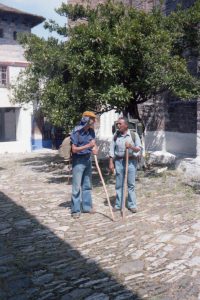
Since that visit I have been to Athos on eight separate occasions, and have seen most of the 20 monasteries. Most of the visits have been in the company of George Poulos, although the last few visits have been with the Footpath Pilgrimage organised annually by the Friends of Mount Athos. These visits have been a real blessing because they have provided a very much better opportunity to get to know Athos and its unique way of life. As a ‘tourist’ one is constantly on the move between monasteries, and there are few opportunities for taking to the monks. On the footpath pilgrimage a small party of men stays as guests of a monastery for a week, clearing the footpaths in the vicinity, before moving on to another monastery for the second week. This provides a much deeper and more satisfying experience.
My visits to Mount Athos
June 13-18 1979
June 14-17 1986
May 9-12 1980
June 20-23 1995 (click here for a partial account)
July 9-12 2001
Oct 17-19 2011
May 18-30 2013 (click here for post-visit thoughts)
May 10-24 2014
May 13-27 2016 (click here for a report to FOMA)
May 6-19 2018 (click here for a diary account)
Sept 19-Oct 2 2021 (click here for account)