Uncle Richard remembered
Uncle Richard was a great favourite of mine. In some ways I felt closer to him than I did to my father. I didn’t get to know him when I was a child: he visited Mexico at one point, but it was a brief visit, and didn’t make much impression on me. I got to know him better when I lived in London in 1973/74. Sherry and I would visit him and Granny at weekends, and we did that again after we returned to London in 1979.
Richard was the eldest of three sons: my dad Charles was the middle one, and Henry was the youngest. Richard showed musical ability from an early age, and he went to prep school in Salisbury as a chorister. My father followed him at age 7, and from all accounts he had a miserable time. He wasn’t a chorister, for one thing, and for another he was not given any protection by Richard. When Henry went to the same school, my father (according to family lore) went out of his way to look after him, something which Richard hadn’t done for him. My father and Henry were as a result much closer emotionally, and Richard was, I think, viewed with some reserve by both of them.
Richard was old enough to see active service during the war. I’m not sure which regiment he was with, but he had some connections in later life with the Honourable Artillery Company. He served in Mesopotamia, and wrote regularly to his mother. The letters were preserved by Granny, and towards the end of Richard’s life they were all sent to the Imperial War Museum, where they are preserved in the archives.
I’m not sure what Richard did immediately after the war was over, but at some point he decided to train for ordination. According to my grandmother, Richard’s father Vaughan was not at all happy with this decision. Vaughan worked at the Bank of England, and I suppose that he wanted Richard to pursue a career in the City or some such thing. Richard was ordained and served his curacy in a parish in Yorkshire. His brother Henry had gone to what was then Rhodesia and joined the Rhodesian Police Force. Richard went out to Rhodesia too to look after a parish, in or near Bulawayo if I’m not mistaken. He was there for a number of years and traveled quite a lot within southern Africa. I know he enjoyed his time there. However, there was a cloud which became increasingly dark, and it was the move of many whites in Rhodesia to take measures to preserve their privileged position and which culminated in the Ian Smith’s Prime Ministership and the 1965 ‘Unilateral Declaration of Independence’. Richard and his brother Henry ended up on opposing sides: Richard wanted no truck with Ian Smith’s racist vision while Henry was committed to Smith and his government.
I’m sure that the situation in Rhodesia contributed to Richard’s decision to return to the UK, but another reason was that his mother, my Granny, was living alone in Bridport. Richard was given a position in a parish in Kingsworthy near Winchester, and Granny went to live with him. She lived the rest of her life with him until her death at 101 in 1992. After his time at Kingsworthy Richard was put in charge of two parishes to the north of Winchester, Littleton and Crawley, and he served as vicar there for many years until his retirement.
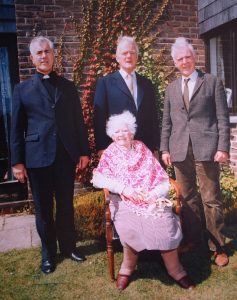
What can I say about Uncle Richard? From my perspective he was a man with a big heart and a great zest for living. He was probably one of the most eccentric people I have ever known. There are lots of ‘Uncle Richard’ stories in the family. There is no doubt that he was very good to Granny, who seemed to thrive on village life and on being the mother of the vicar. He looked after her well, but to casual observer he could be quite cruel at times. I think in fact that it was far from cruelty: it was a respect which meant that he never patronised her and in her increasing old age and infirmities he would challenge her to exert herself and to take responsibility for herself. I think this was important, because there was a childish aspect to Granny in which I suspect she could have become very dependent psychologically, and he helped to prevent this from happening. We all have stories, as for example when he would say ‘Right, Mums, we’re off’ and Granny would put on her coat and scurry out to the car. Half an hour later she would be sitting in the car while Richard was sitting at the piano inside playing a piece of music.
Sherry and I often wondered at how Granny and Uncle Richard survived in terms of food and nourishment. Granny absolutely refused to do any significant cooking, other than to occasionally make a batch of biscuits, and Richard had a very cavalier attitude towards cooking. He would brew up a large batch of porridge which would be re-heated every morning until it was finished, and would do the same with a stew for the evening. They ate a lot of bread and marmalade and boiled eggs. They would often get in the car and go to the Little Chef in a motorway service station nearby to have lunch. When Sherry and I went for a weekend to visit them it was always perfectly well understood that we would do all the cooking, and we were of course happy to do that. However, our first task on arrival was always to try to wash up enough pots and pans and plates and cutlery to be able to cook and eat the next meal!
Uncle Richard bought a dishwasher when he was in Kingsworthy. Initially it was installed in Granny’s bedroom, and he would rush up the stairs just before she retired and switch it on. It made a horrible noise, but Granny as far as I know never objected. Eventually it was brought down to the kitchen. Sherry and I viewed it with some alarm, because it always contained a build-up of unsavoury deposits. There was no mystery to this, because Richard would get very upset when either of us rinsed off plates or pans before putting them in. There was no point in having a dishwasher if it didn’t do everything! So plates, complete with chicken bones and large patches of mustard would be put in the hapless dishwasher, which was left to eventually bake some of this stuff onto the glazing to such an extent that the plates could never be fully cleaned by hand. On arrival Sherry and I would wait for a convenient moment (usually when Richard was out) to empty and clean the filters on the dishwasher.
Richard never married. I think this sometimes distressed Granny. I think at one point she hoped that a friend of theirs (FR) would come up to scratch, but it wasn’t to be!